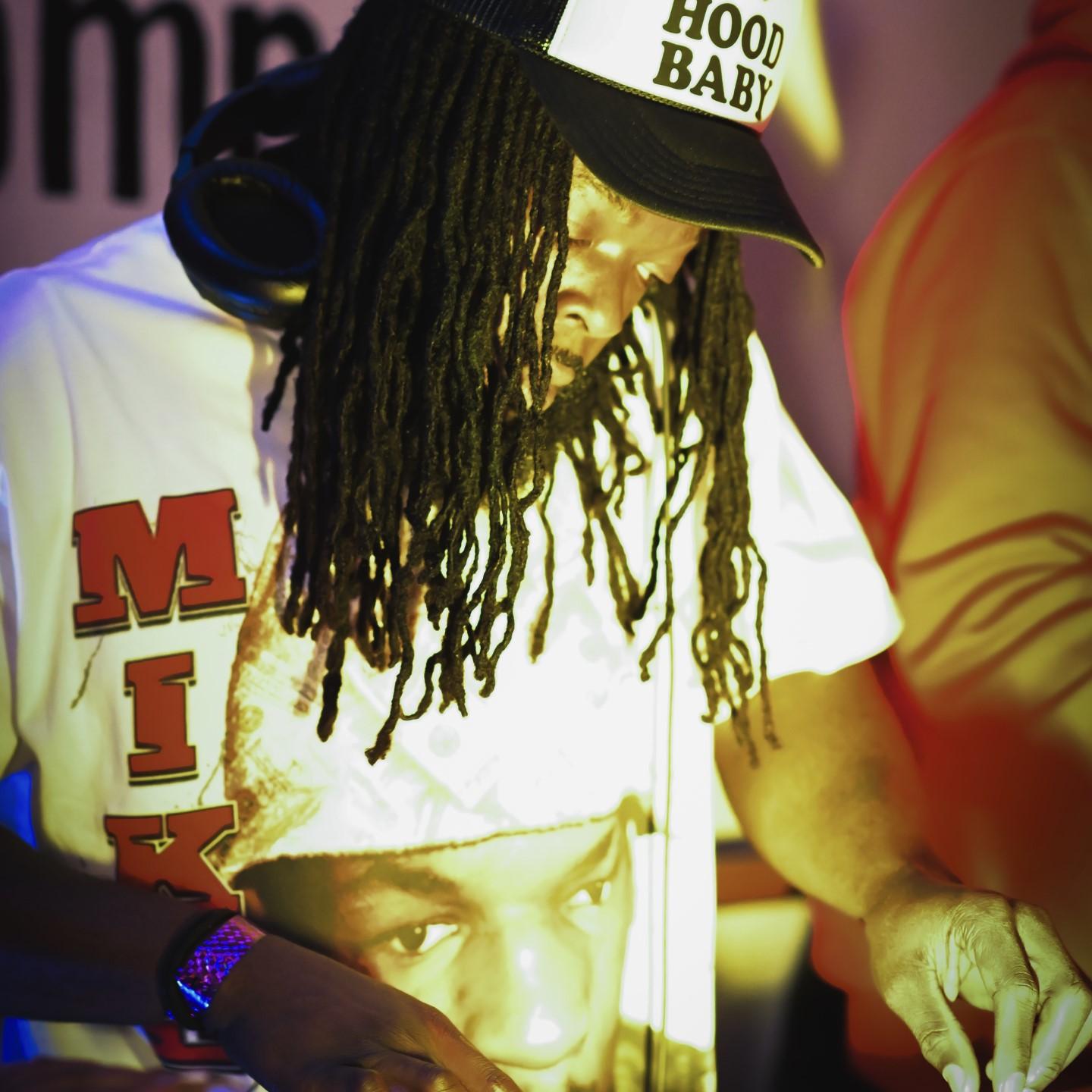
DJ TiGa
Biografía
In a similar way to how footwork and juke traits eventually transcended the zip code confines in which they were formed, Jersey club emerged through the broadening of online distribution channels and a non-linear merger of styles across different cities. As a creative outlet, it was responsible for instigating rivalries on the streets of Newark as much as it provided respite — at least for some — from unemployment, political frustration, and a lack of opportunity. For this reason, the music often exposes a panoply of diverging moods and expressions in its current form. It can be as furious and foul-mouthed as it can be focused and contemplative, while at the same time consistently adhering to the central, driving principles that define it: a visceral stampede of rhythm and a call for kinetic responses from the audience.
As a young teen, New Jersey producer DJ TiGa was so inspired by the fired-up music of Newark-based Jersey club collective Brick Bandits that he went on to join them. Now with over 20 years of producing experience under his belt, he has proven to be one of the leading pioneers of the contemporary Jersey club sound. His Lit City Trax released 'The Sound: Vol.1' mixtape was designed to introduce the world to DJ TiGa's flexible take on one of dance music's most mutable forms. Every DJ TiGa production is an infectious listen that turns time signatures upside down and inside out, lending ballads a funky edge and turn-up tunes a touch of melancholy.
DJ TiGa's debut full length came roughly 10 years after the arrival of Jersey club on the world stage. As Mike Steyels discussed in his 2015 Resident Advisor feature on the subject, the internet gave producers such as Brick Bandits a gateway to new audiences and support channels, which led to an even more open dialogue as to how the style would evolve. On 'The Sound: Vol. 1', DJ TiGa has noted DJ Rashad and DJ Spinn as key influences, while allowing their respective beat patterns to bleed into the mix — see “sTICK’em” or “Asking All Them Questions,” in particular. But that doesn’t mean this mixtape is solely dependent on the groundwork of others; DJ TiGa brings his own flavor at almost every turn, leading to two defining features of the mix: the invitation of listeners to be a part of a localized stylistic formula and contrasting observations from both the club and the street.
In a similar way to how footwork and juke traits eventually transcended the zip code confines in which they were formed, Jersey club emerged through the broadening of online distribution channels and a non-linear merger of styles across different cities. As a creative outlet, it was responsible for instigating rivalries on the streets of Newark as much as it provided respite — at least for some — from unemployment, political frustration, and a lack of opportunity. For this reason, the music often exposes a panoply of diverging moods and expressions in its current form. It can be as furious and foul-mouthed as it can be focused and contemplative, while at the same time consistently adhering to the central, driving principles that define it: a visceral stampede of rhythm and a call for kinetic responses from the audience.
DJ TiGa’s first installment from his mixtape series comes roughly 10 years after the arrival of Jersey club on the world stage. As Mike Steyels discussed in his 2015 Resident Advisor feature on the subject, the internet gave producers such as Brick Bandits (of which TiGa was also a member) a gateway to new audiences and support channels, which led to an even more open dialogue as to how the style would evolve. On The Sound Vol 1, DJ TiGa has noted DJ Rashad as a key influence, while allowing their respective beat patterns to bleed into the mix — see “sTICK’em” or “Asking All Them Questions,” in particular. But that doesn’t mean this mixtape is solely dependent on the groundwork of others; TiGa brings his own flavor at almost every turn, leading to two defining features of the mix: the invitation of listeners to be a part of a localized stylistic formula and contrasting observations from both the club and the street.
In an interview with THUMP, DJ TiGa talked about the social abstractions associated with club and street life and how they interact in his music. From the outside, the inclusion of shotgun-pumping and gunfire alongside gentle vocal sections courtesy of R&B heroine Tink, among others, exemplifies an immediate clash. But this is softened by the inclusion of shimmering melodies against rapid-fire kick drum that feels more like cohesion than conflict. The physical action that this music provokes only complements such beautifully executed juxtapositions — it’s music for the club as temple. The ritualistic moves that make their way into the encyclopedia of physical responses call for an instant fascination as to how this music works its audience and how the audience construct their counterattack - “club music isn’t beautiful” DJ TiGa told Alexander Iadarola. “It’s supposed to make you sweat, you’re supposed to jump, you’re supposed to be able to scream to the top of your lungs.”
Artistas relacionados
House +1


Woodson
Haití
House

Cidoine
Haití
Afro House

Gardy Girault
Haití
House +2

Babak (HT)
Haití